Charitable Trust Tax Planning

building and operating business tax exit play

This is part one of a video series discussing various advanced tax planning concepts.  The majority of this discussion covers charitable remainder trusts. Feel feel to watch the video or read the transcript.

John And Mary Smith likes to sell their 11 million dollar business. The total value of the assets (Business and Commercial Building) is around 11 Million Dollars. If they do nothing, their tax with the business will cost them around $1,650,000.000 and $2,000,000 for the commercial building. They go home with 7.35 Million, and the IRS goes home with 3.65 Million.

Using Charitable Trust
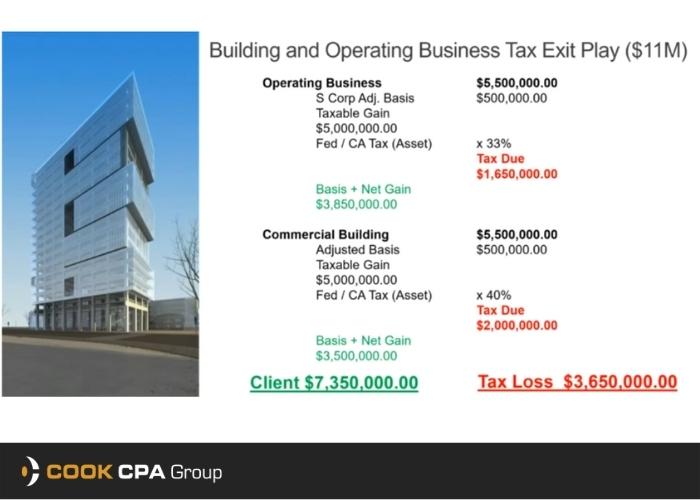
building and operating business tax exit play

A charitable trust is an irrevocable trust. A charitable trust is a tool that has two jobs. One, to give you an income stream normally for life, and when you and your spouse die, whatever is left in that trust goes to the charitable structures you like. This could be Red Cross, Salvation Army, or whatever charity comes to mind.

We put the building in this charitable trust. This charitable trust is a tax-exempt irrevocable trust.  By doing this, we bypass all the capital gains and recapture tax. So, in this case, if they put a 5.5 million dollar highly appreciated building into a charitable trust, there’s no tax. Another benefit is that the IRS is going to give them a charitable income tax deduction, in this case, 1.65 Million Dollars.
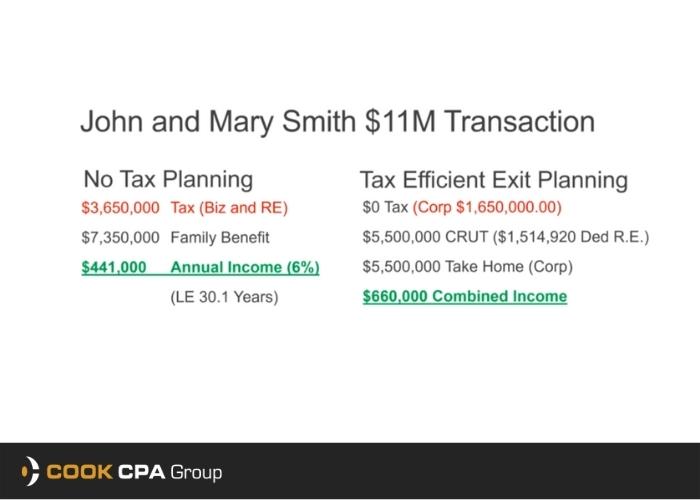
john and mary smith transaction

So if they sell the business and donate that building into the charitable trust, they’re almost going to be zero tax. It may take them a couple of years as far as tax returns to enjoy all these benefits, but it boils down to higher annual income.

Now you may say, that their kids aren’t getting the value of that building when they die. Then, let’s just use some money to buy a life insurance policy to replace that value. In effect, the IRS just paid for the life insurance policy.
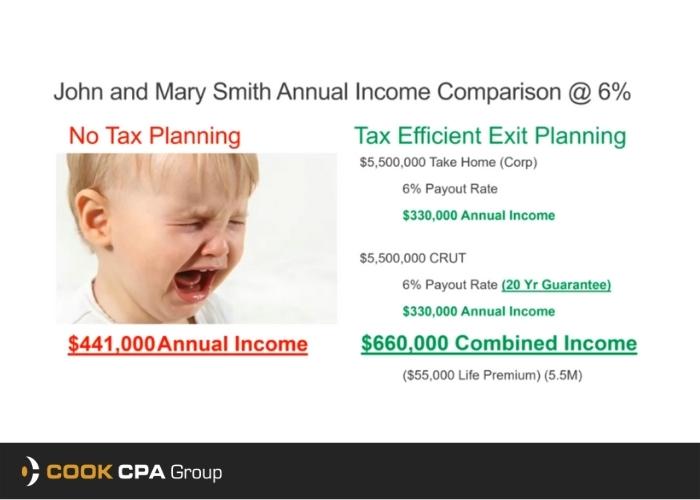
john and mary smith annual income comparison

This strategy is not new. It’s just new to some people or even you. So when you hear people talking about charitable tax planning, those are the people who have figured out that there’s a way that we can do more good for everybody involved and put a lot of money in the hands of a charitable organization.

We’ve done several strategies now on the death of John and Mary. We’ve done seven million dollars going to charity.  We replace the value going to the charity using life insurance.  The life insurance all goes tax-free, assuming the law doesn’t change in respect to step up in basis rules. We’ve increased the income to 159,000 a year for the rest of their life.
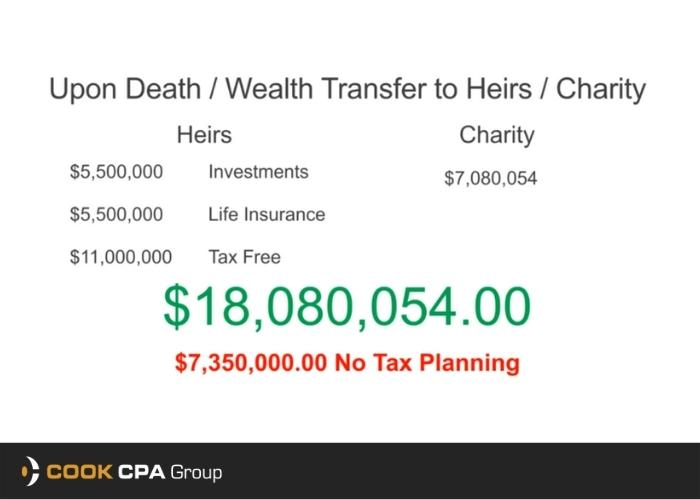
tax savings upon death


A Tax Strategy You May Be Missing

One of my joys in April (just before tax season is over) is getting the iPad all cleaned up and updating the app to watch the Masters. The beautiful course is a needed refresher that helps me to persevere the last few days until April 15. The scenery is stunning, the competition is rigorous and the unexpected seems to happen. The app has many ways to watch the competition such as focusing on specific holes like Amen corner or player groupings. As my mind drifts into a post tax season mode, I wonder what it would be like to watch in person one year.

Augusta tax rule
Amen Corner at Augusta Golf Club

There are houses on the course that one must be able to rent….

How much is it to rent?  Do they pay taxes on the rental income?  Surprisingly, the answer to the tax question is they probably don’t pay taxes: the tax code has something called the “Augusta Rule.”  This strategy was created to allow residents of Augusta, Georgia to rent their homes during the Masters’ golf tournament, without having to include this rental income on their tax returns.

The Augusta Rule 

The Augusta Rule has become a tax planning strategy that allows your business to pay rent to you for the purpose of holding business-related meetings in your primary residence or vacation home. For example, if you have a monthly meeting with the board of directors, your company can pay a reasonable amount to rent your home to conduct these meetings. Your company gets to take an expense deduction on the business tax return and you do not have to report the income on your personal tax return. This can be used for a maximum of 14 days each year. Keep in mind that if you go over the maximum of 14 days, you will have to report the entire rental income, and you will not receive any tax benefit since you will have to report the money as rental income on your personal return.

Tax Savings for Your Business 

According to the Augusta rule, you can rent out your home to your business (or for other purposes like Airbnb) for a total of up to 14 days each year. This home can be located anywhere in the United States, and the income from the rental will be excluded from your taxable income. For example, a rental expense of $35,000 (paid to you) generates your corporation $7,350 in tax savings while providing you $35,000 of tax free income.

Establish Rental Rate  

To establish a reasonable rental price you first need to document local pricing standards. You can do this by contacting at least three local establishments where businesses would normally have meetings, such as country clubs or hotels, to get an idea of venue costs in your area. 

You can use your home for a variety of business purposes, including planning sessions and even company parties. It’s recommended that you schedule your meetings in your calendar system and send out an agenda, if possible, since this provides additional documentation at tax time. 

There is no minimum participant requirement for these meetings, but keep in mind: 

  • The daily rental rate doesn’t include the cost of business meals. 
  • The home can’t be considered a full-time rental property. 
  • If you rent out your home for more than 14 days, you’ll have to report all of the income, and you won’t get the tax benefit.

Execute a Rental  Agreement 

To comply with the tax code, a written rental agreement is required between yourself and your company.  Additionally, thorough documentation supporting the rental price must be maintained as well as meeting documentation such as meeting minutes or notes.

Furthermore, to take advantage of the Augusta rule, the business entity structure must be an S corporation, C corporation, or partnership. It can’t be a Schedule C (self-employment income), unless the entity is a Single Member LLC. 

So, if you want to make your accountant and other employees happy, post tax season, consider scheduling a tax planning meeting at your house, on that course near the Masters…and we can help you be compliant with IRS regulations.

Augusta Rule
Augusta Golf Club at Sunset
References: Internal Revenue Code sections and related regulations include PLR 8104117; IRC Section 280A; IRC Section 274(a)(1)(B);IRC Section 267(a)(2); IRC Section 262; IRC Section 162; Gregory v Helvering, 293 U.S. 465 (1935); Frank Lyon Co. v United States, 435 U.S. 561, 573 (1978); Rev. Rul. 76-287; Leslie A. Roy v Commr., TC Memo 1998-125 PLR 8104117